

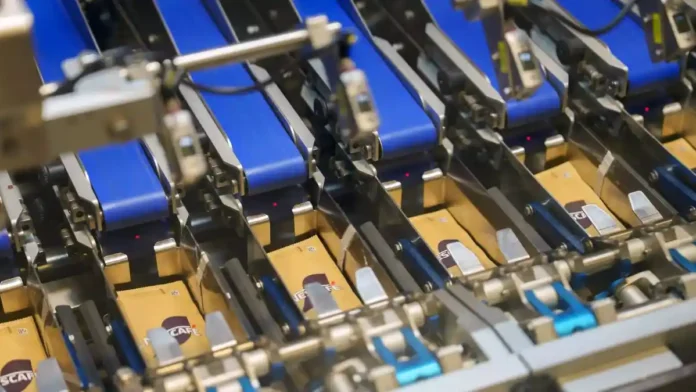
Nestlé has released the final episodes of its Amazing Machines series, opening up two of its largest UK production sites and revealing the scale, speed and automation behind some of Britain’s most widely distributed FMCG products.
The films focus on the Dalston factory in Cumbria, home of Nescafé Frothy Coffee sachets, and the Nestlé Waters & Premium Beverages bottling facility in Buxton, Derbyshire.
For the grocery sector, the story is not about YouTube content. It is about manufacturing throughput, packaging automation and domestic production resilience at scale.
60,000 sachets an hour in Cumbria
At Dalston, Nestlé operates one of its fastest packaging systems in the UK.
The bespoke UP One line produces up to 60,000 cappuccino sachets per hour. Weekly output exceeds 25 million Nescafé sachets.
Production begins on site. Raw milk is dried into milk powder, blended in the factory’s dry mix tower and transferred directly into the packaging system. Finished sachets move from bagging to palletising in under three minutes, fully automated.
High-speed cameras monitor output frame by frame. Robotic arms pack cases and move pallets through to the warehouse.
The entire line is designed for precision at speeds beyond human visual tracking.
For retailers, this matters because sachet coffee is a high-volume, price-sensitive category. Output stability at this level reduces supply disruption risk and supports promotional cycles.
40,000 bottles per hour in Buxton
At the Buxton facility in the Peak District, Nestlé Waters & Premium Beverages bottles Buxton natural mineral water alongside Nestlé Pure Life, Acqua Panna and S.Pellegrino products for the UK market.
The site produces more than 40,000 bottles per hour.
Preforms made from 100% recycled PET are blown into shape on site. Bottles are filled at speeds of 11 units per second, capped to controlled torque levels and labelled before robotic palletisation.
High-speed camera systems check positioning and sealing integrity throughout the line.
An on-site storage centre can hold around 30,000 pallets before national distribution.
For supermarkets, this is core supply infrastructure in the bottled water category — one of the UK’s highest-volume packaged beverage segments.
Automation and downtime control
Both sites demonstrate how FMCG production has shifted toward tightly integrated automation.
Robotics handle case packing and palletising. Vision systems flag defects instantly. Engineers manage line optimisation to minimise stoppages.
In high-volume grocery categories, downtime directly impacts shelf availability. Advanced monitoring systems reduce that risk.
This level of automation also supports tighter quality assurance, especially in beverage packaging where cap torque, fill levels and label positioning are compliance critical.
Packaging sustainability signals
The Buxton facility’s use of 100% recycled PET preforms is a clear packaging signal.
With UK retailers under pressure to reduce virgin plastic use and meet recycling commitments, supplier-side rPET integration is becoming structurally important.
On the coffee side, high-speed sachet packaging reflects ongoing efficiency gains in flexible packaging formats, though sustainability considerations around multilayer sachets remain an industry-wide issue.
From a trade perspective, the key takeaway is production capability aligned with scale and compliance — not promotional messaging.
Workforce and technical expertise
The films also profile apprentices, engineering graduates and operational leads working across packaging innovation, start-up engineering and shift management.
Behind the automation sits a large technical workforce managing maintenance, calibration and process control.
In the UK manufacturing context — where capacity security has become more strategic post-Brexit — maintaining domestic engineering capability is part of long-term supply chain resilience.
Why this matters for grocery
Nestlé’s Dalston and Buxton operations illustrate three themes relevant to supermarkets:
• High-volume domestic production capacity
• Robotics and automation supporting reliability
• Increasing integration of recycled materials in beverage packaging
In categories such as instant coffee and bottled water, volume consistency is central to price architecture, private label competition and promotional execution.
The Amazing Machines series concludes with these two sites, but the operational data points show something more significant.
Modern UK FMCG production is highly automated, highly monitored and operating at speeds that require advanced engineering rather than manual oversight.
For buyers and supply chain teams, the message is clear: production scale and packaging precision remain foundational to shelf availability across core grocery categories.