

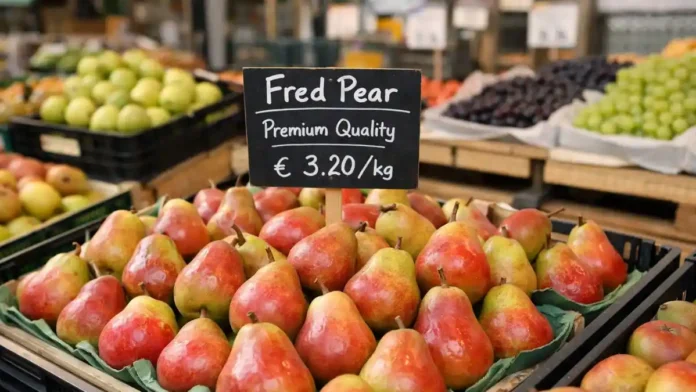
European pear variety Fred is on track to double its production volume by 2030, as growers expand acreage and retailers increase demand for premium fruit lines.
Current Fred pear output stands at around 4,600 tonnes in 2026, with plans to reach 9,000 to 10,000 tonnes by the end of the decade. The variety has been in commercial cultivation for five years and continues to expand across multiple European growing regions.
France remains the main production hub, accounting for around 80% of the European harvest in 2025. Belgium and Italy are expected to contribute a combined 35% share by 2030, reflecting strong grower adoption and expanding planting programmes.
In Belgium, Fred pears are grown under the coordination of the BelOrta cooperative, covering roughly 30 hectares, with part of the harvest exported to Germany. Switzerland currently cultivates the variety on about 20 hectares, producing close to 500 tonnes, while Italy hosts more than 50 hectares of commercial plantations.
Older orchards are now entering full production cycles, with peak yields expected over the next two years. Growing conditions in 2025 supported strong sugar levels, while demand has remained higher than available supply.
The Fred pear is positioned as a premium retail product, targeting higher-value fruit segments. The variety is marketed for its firmness, crisp texture and slower softening rate, making it suitable for snack consumption and longer shelf presence at store level.
The commercial sales window typically runs from October through Easter, supported by controlled atmosphere storage. In Switzerland alone, around half of the current harvest volume is already stored in CA facilities.
Pilot plantations in the Netherlands and Germany are also showing positive results. Expansion in these markets will depend on yield consistency and storage capacity development, which are seen as key factors for long-term supply stability.
Editor’s Note: This report is based on verified industry trade information and company disclosures related to the commercial development of the Fred pear variety across European growing regions. Figures reflect market conditions and production planning shared by involved supply partners.


