

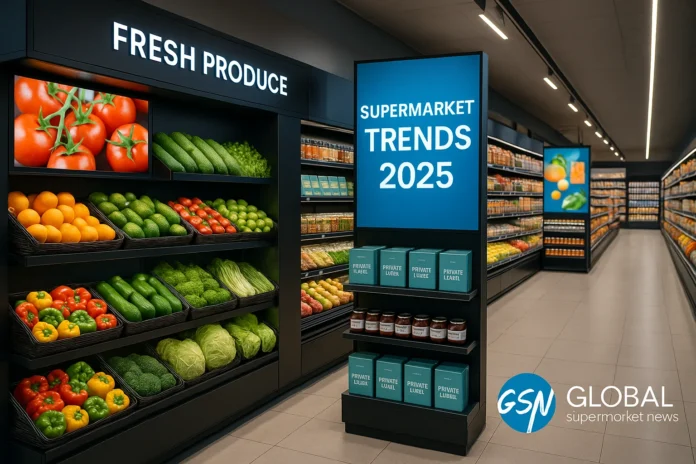
Your essential guide to where grocery retail is heading next
What are the top supermarket trends in 2025?
Shoppers are cutting back — but expecting more.
Retailers are chasing efficiency — but can’t afford to lose loyalty.
And suppliers? They’re under pressure to deliver faster, cheaper, cleaner… and smarter.
From AI-driven retail tech to the rebirth of private label, the supermarket of 2025 looks nothing like the one you grew up with.
Here are the trends reshaping the global grocery game.
✅ 9 Key Supermarket Trends to Watch in 2025
-
Private label is no longer second tier
-
Inflation reshapes how shoppers buy
-
Retailers double down on loyalty ecosystems
-
AI, smart shelving & automation go mainstream
-
Sustainable packaging becomes table stakes
-
Discounters expand across global markets
-
Regional sourcing rises
-
The fresh produce category gets a digital upgrade
-
Retail media networks grow into full revenue streams
Now let’s break it all down.
1. Private label is no longer second tier
Retailers are investing in own brands like never before — not just for margin, but for loyalty, storytelling, and innovation.
Premium-tier private label, wellness-focused ranges, and differentiated packaging are becoming standard.
2. Inflation reshapes how shoppers buy
Shoppers are more selective. They want value, not just low price.
We’re seeing:
-
Smaller basket sizes
-
More private label switching
-
Increased promo sensitivity
-
Bulk buying of core staples
Retailers are adapting with price-lock zones, loyalty-only discounts, and “essential value” campaigns.
3. Loyalty ecosystems are the new front line
Supermarkets in 2025 don’t just run loyalty cards — they run full ecosystems:
-
Digital coupons
-
App-only offers
-
Data-driven pricing
-
Media personalisation
The goal? Keep shoppers looped in, logged in, and locked in.
4. Retail tech goes mainstream
AI and automation aren’t buzzwords anymore. They’re tools supermarkets now rely on:
-
Smart shelving with real-time alerts
-
Dynamic pricing tools
-
Predictive demand engines
-
Chatbots for CS + ecommerce
Retailers want more efficiency — and more insight — with fewer staff and tighter budgets.
5. Packaging must now meet ethical expectations
It’s not “nice to have” — it’s a filter.
Suppliers that want listings must meet retailer packaging goals:
-
100% recyclable
-
Plastic reduction
-
Compostable or refillable
-
QR-linked transparency
6. Discounters are expanding and winning
ALDI, Lidl, and other discounters are taking share fast — especially in inflation-hit economies.
They’re opening stores, launching new private label lines, and attracting younger shoppers.
National chains are responding by copying discount tactics — and cutting complexity.
7. Regional sourcing gets a lift
Retailers are embracing products with a local story.
That includes:
-
Regional produce
-
Localised private label
-
Short-haul suppliers
-
Hyper-local farm networks
Shoppers want authenticity — and retailers want less exposure to global supply shocks.
8. Fresh produce goes digital
Fresh is no longer “too complex for ecommerce.” In 2025:
-
Produce gets real-time freshness tracking
-
Smart expiry and markdown alerts increase
-
QR codes give origin and sustainability info
-
Dark stores expand for rapid delivery
Fresh is the new battleground for premium and convenience shoppers.
9. Retail media becomes a full business unit
Supermarkets are no longer just sellers of food — they’re advertising platforms.
With loyalty data, app traffic, and in-store screens, retail media networks now offer:
-
Sponsored search
-
Digital shelf ads
-
Aisle-targeted video
-
Supplier-funded placements
It’s a new profit stream — and a new battleground for brand visibility.
Final Thoughts: The supermarket of 2025 is leaner, smarter — and more competitive than ever.
For suppliers, the takeaway is simple:
-
Be visible in the trade press
-
Show value through innovation
-
Think digital, even in-store
-
Fit the retailer’s story — not just your own
And for retailers?
The winners will be the ones who combine tech, trust, and total shopper understanding.


